Your next tyre sale might come with software attached.
Michelin has formalised its universal tyre digital twin, a software driven system that can predict tyre behaviour in real time without a single additional sensor fitted to the wheel.
The technology is not a concept. It is the product of more than ten years of research and development, validated across several million kilometres of testing, and is now being positioned for deployment across passenger cars, trucks and self driving shuttles.
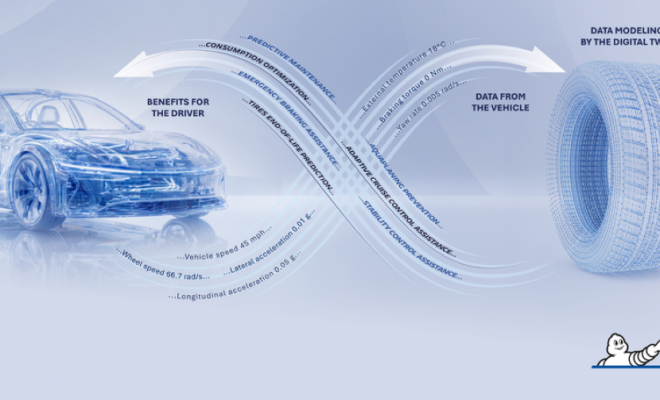
At its core, the digital twin is a dynamic virtual replica of a tyre. It continuously analyses pressure, wear, load, grip and driving conditions, cross referencing that picture against existing in vehicle data. The system then feeds directly into the vehicle’s embedded systems rather than simply reporting information to a dashboard.
For workshops and tyre retailers, the practical implication is significant: this works across all tyre brands and all vehicle types, with no hardware installation required.
The safety outcomes the system targets are ones any workshop technician will recognise as priorities: predicting maximum grip, preventing aquaplaning, reinforcing the effectiveness of ADAS systems including ABS, monitoring tyre pressure and flagging overloading before it becomes a problem. Michelin claims the system can adapt braking distances by as much as several metres.
A collaboration with Brembo has provided a tangible early proof point. Integrating Michelin’s tyre condition data into Brembo’s Sensify intelligent braking system demonstrated braking distance reductions of up to 4 metres and improved stability during hard braking. The partnership is one of several, with Hyundai, QNX, ETAS and Sonatus also involved across the spectrum from fundamental research through to industrial integration.
The system is also designed to extend tyre life through predictive maintenance, keeping tyres in optimum operating condition for longer and reducing material consumption across the tyre lifecycle.
The broader commercial context for Michelin is the rapid transition toward Software Defined Vehicles. SDV architecture allows vehicle performance, features and user experience to be updated continuously over the vehicle’s lifetime. Michelin is positioning its digital twin as a foundational layer within that architecture, turning the tyre into a live data source at the centre of the vehicle’s intelligence rather than a passive component at the bottom of it.
For workshops currently fitting Michelin stock, the message is straightforward. The tyre is becoming software. What gets sold with it is going to change.